A routine inventory of a retired faculty member’s laboratory has led to the unexpected recovery of two biological specimens that had been missing for more than four decades. The specimens, which had been considered lost since 1980, are now on their way home to the North Carolina Museum of Natural Sciences in Raleigh, formerly called the North Carolina State Museum of Natural History.
The Discovery
The recovery occurred during a project to repurpose an old research lab within Ohio State Lima’s biology department. Jordan Halley, a student assistant tasked with cataloging and cleaning the room’s contents, discovered a copy of an old invoice in a drawer filled with the types of things a well-used room collects over time, like plates, a thermometer, random papers.
The invoice was for 40 Desmognathus fuscus specimens in one lot and two Desmognathus fuscus larvae in another. Both had arrived in Lima in the summer of 1980 for use by Dr. J. Eric Juterbock. The big shipment went back when Juterbock finished his comparisons, but the larvae specimens did not. They became a mystery written off as lost in the museum’s records.
The lab contains specimens collected over a career’s worth of research that are largely in clear glass and plastic jars. When Jordan found something that looked more like an old-fashioned coffee container wrapped in brown paper, he paid attention. It was tucked behind other containers on a shelf oriented in just a way that you wouldn’t notice it if you weren’t meticulously sorting through the contents. The point of origin on the label matched the invoice he had found earlier.
“It was surprising. I told Mrs. Risner I was going to go off to explore while she was writing down an inventory for some VHS tapes. I was just opening drawers and found the paperwork,” said Jordan, a food, agricultural and biological engineering major. “While she was reading the invoice from a museum, I went off exploring again. I moved a specimen and there they were sitting back in a corner. I picked up the container because it looked abnormal.”
Attention to Detail
Nancy Risner, who is overseeing the reorganization of the lab, praised Jordan’s persistence and quick eyes.
“Jordan is the hero of the department,” said Risner, lecturer in biology. “He was able to uncover the paperwork and the thing that went with the paperwork all in the same day. Such great attention to detail and some eagle eyes.”
Returning to North Carolina
The specimens that arrived by parcel post 46 years ago are still viable and have been carefully packaged and sent off to North Carolina to rejoin their original collection. Risner and Halley have catalogued the big pieces in the lab and will soon move on to sorting through the hundreds of specimens.
* * *
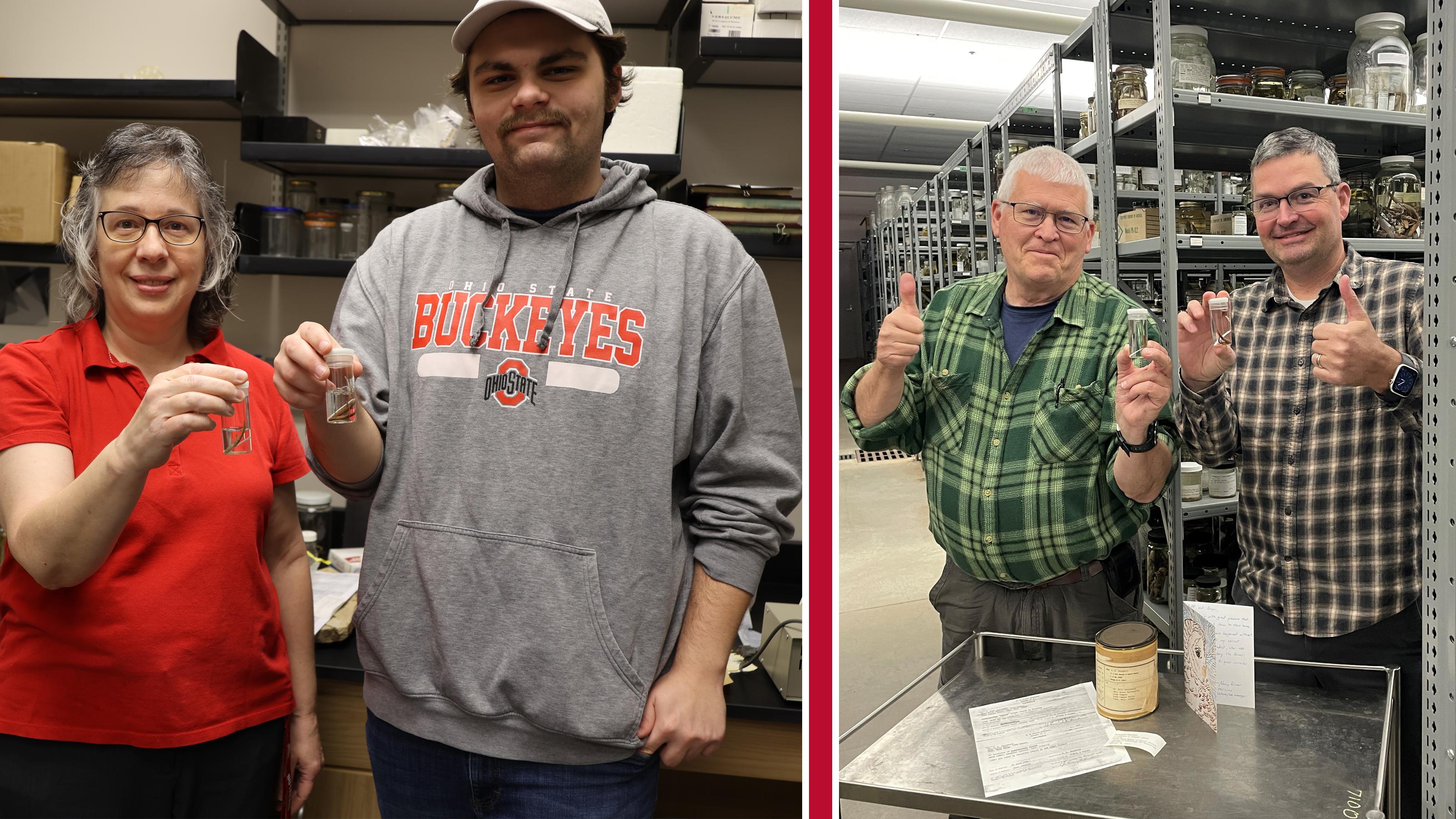
Photo, above: (from left) Nancy Risner and Jordan Halley of Ohio State Lima and Jeff Beane and Bryan Stuart of the North Carolina Museum of Natural Sciences.
* * *